Hierapolis
A Roman spa town on top of the white travertine terraces of Pamukkale, entered along a road lined with tombs. World Heritage, together with the travertines, since 1988.
Plan your visit
For a first visit at an easy pace.
Opening hours and prices change: see muze.gov.tr (opens in a new tab).
Times are our estimates. Distances are straight lines.
Where it is and how to get there
In south-west Türkiye, in Denizli province, on a terrace above the valley of the Çürüksu (the ancient Lycus), next to the village of Pamukkale. Denizli, the provincial town, is less than 20 km to the south.
The walk, with what you’re looking at
The ancient city sits on a terrace above the white travertine terraces, and its sights are spread along a long street and out among the tombs. The stops below follow the springs first and then the ruins: it is a long walk.
- The travertine terraces
White limestone steps with shallow pools, laid down by hot springs running down the hillside. Most of the terraces are closed to protect them, and only marked stretches can be walked.
- The Roman baths and the museum
The big vaulted baths now hold the Hierapolis Archaeological Museum: sarcophagi, statues and finds from Hierapolis and the towns around it.
- The Antique Pool
A warm spring-fed pool where fallen marble columns lie under the water. You can swim among them, for a fee.
- The Temple of Apollo and the Ploutonion
Only foundations and a few broken columns of the temple remain. Beside it is the Ploutonion, a shrine to Pluto, god of the underworld, where carbon dioxide rises from a cave. The ancients called it a gate to the underworld. The gas is dangerous, so stay behind the barriers.
- The theatre
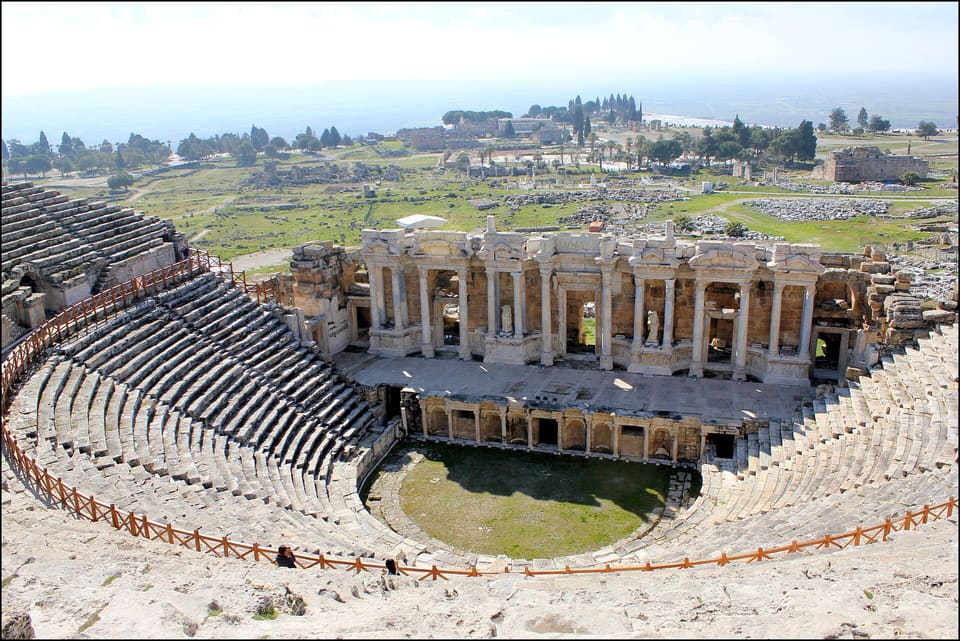
Cut into the hillside and built ahead of a visit by Emperor Hadrian in AD 129. The stage building still stands.
- The main street and the Frontinus Gate
A long paved street with a colonnade on both sides, entered at its northern end through the Frontinus (or Domitian) Gate, a triple arch between two round towers.
- The necropolis and St Philip’s Martyrium
Beyond the north gate, tombs of many shapes (house-like tombs, sarcophagi and mounds) line the old road for about 2 km. Among them stands the ruined, octagonal Martyrium, built in memory of Philip the apostle.
Hierapolis
A holy city of hot water. Springs, a cave that breathed deadly gas and a Roman spa town built over them: the ruins stand on top of the white terraces of Pamukkale.
- 7th century BCA cave and a goddess
The Phrygians raise a temple to the mother goddess Cybele by a hot spring and a cave. Poisonous gas rises from the cave, and people come to think of it as a gateway to the underworld.
- 2nd century BCThe holy city
A spa town grows up by the hot springs under the kings of Pergamon, and takes the name Hierapolis, “holy city”.
- AD 60The great earthquake
An earthquake in Nero’s reign flattens the city, one of many that hit it. It is rebuilt on a grid, like a Roman city, and most of what you see dates from this rebuilding.
- About AD 80St Philip
The apostle Philip, one of Jesus’s disciples, is said to be put to death here. Later an octagonal church, the Martyrium, is built in his memory, and Hierapolis becomes a centre of Christianity.
- AD 129A theatre for an emperor
The theatre is built ahead of a visit by Emperor Hadrian.
- From the 4th century ADA Christian city
Hierapolis is a centre of Christianity and is later made a metropolis, the seat of a leading bishop.
- 7th century ADAnother earthquake
A strong earthquake brings down much of the city, which never fully recovers.
- 13th–14th centuriesA small town, then nothing
Under the Seljuks it is a small town. After another earthquake in the 14th century it is given up.
- 1988World Heritage
UNESCO lists Hierapolis together with the Pamukkale travertines, as both a cultural and a natural site.
- After 1988The hotels go
Hotels that had been built on the plateau among the ruins are taken down. One hotel pool is kept, and it is now the Antique Pool.
Photographs
6 photographs from Wikimedia Commons, each with its author and licence.
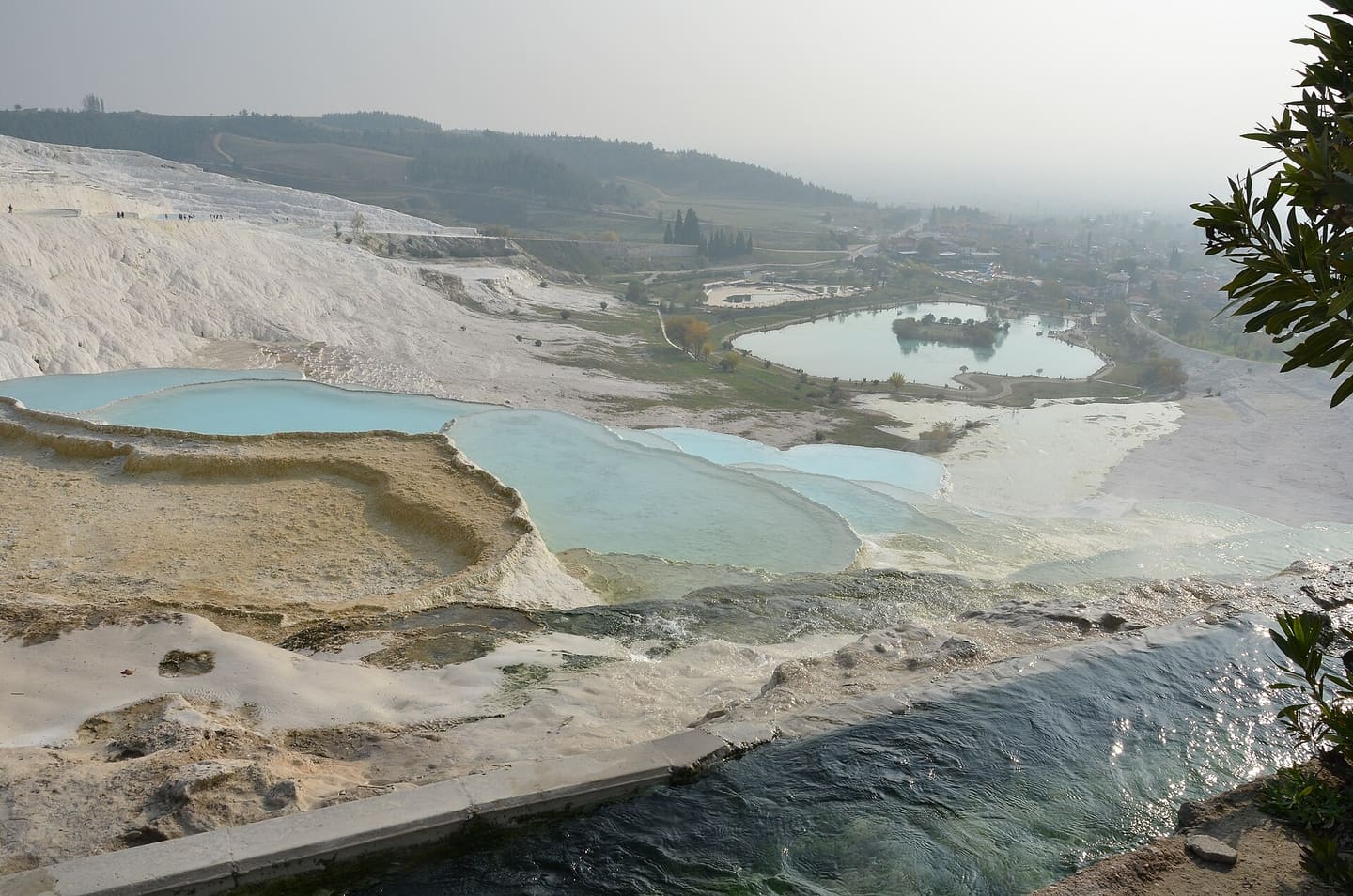
Photo: shankar s. from Dubai, united arab emirates · CC BY 2.0 (opens in a new tab) · Wikimedia Commons (opens in a new tab)
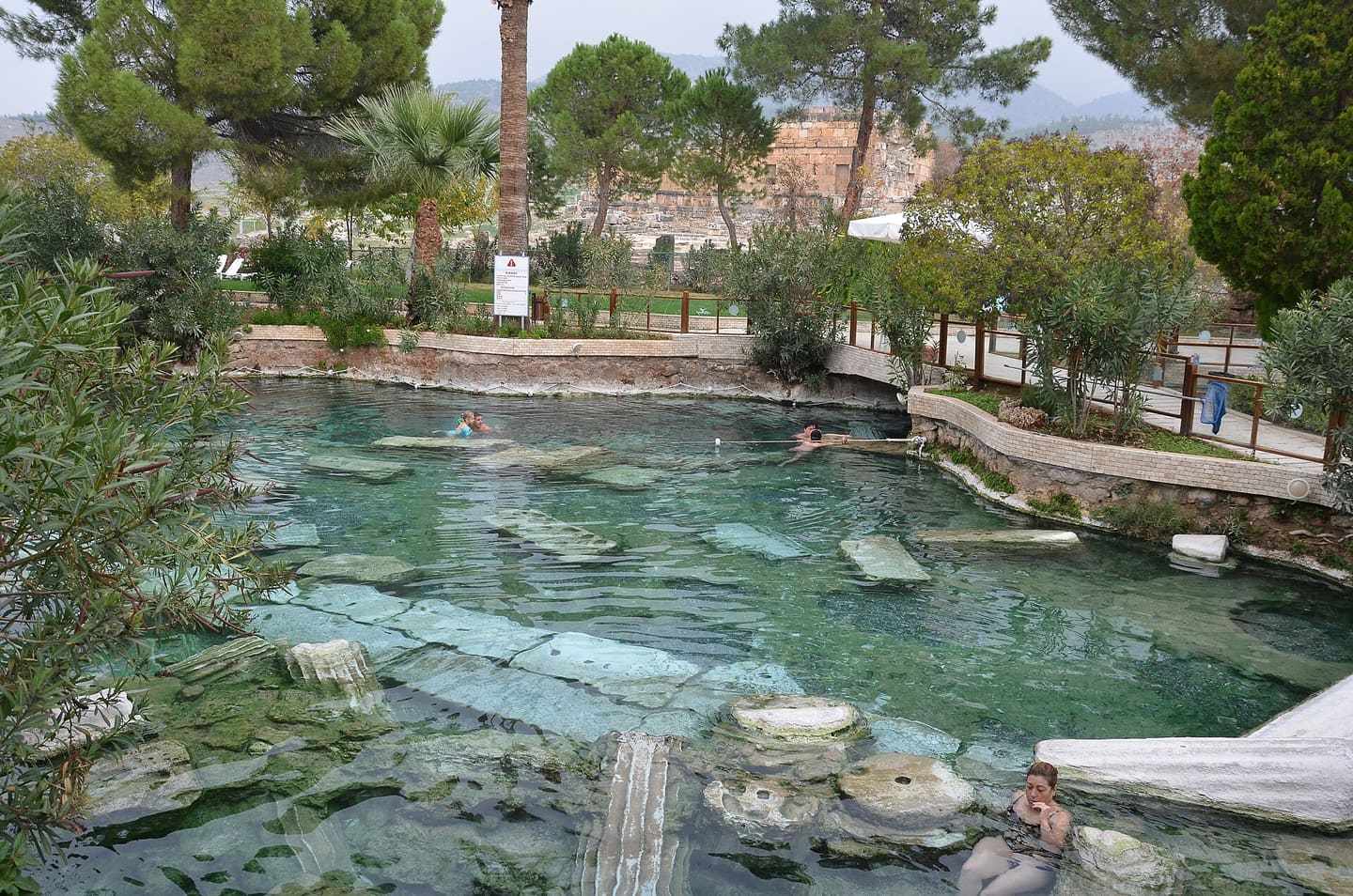
Photo: shankar s. from Dubai, united arab emirates · CC BY 2.0 (opens in a new tab) · Wikimedia Commons (opens in a new tab)
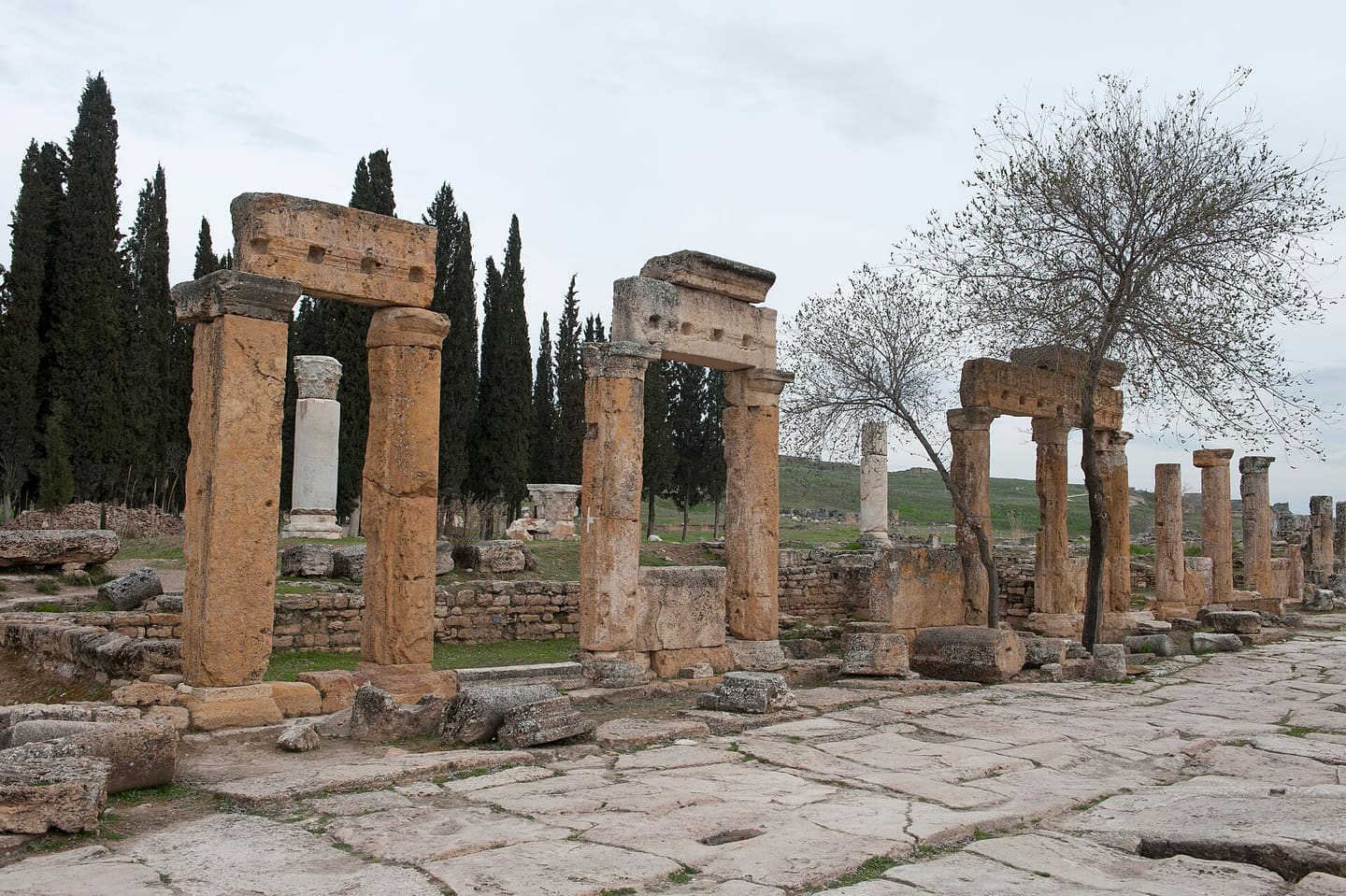
Photo: Dosseman · CC BY-SA 4.0 (opens in a new tab) · Wikimedia Commons (opens in a new tab)
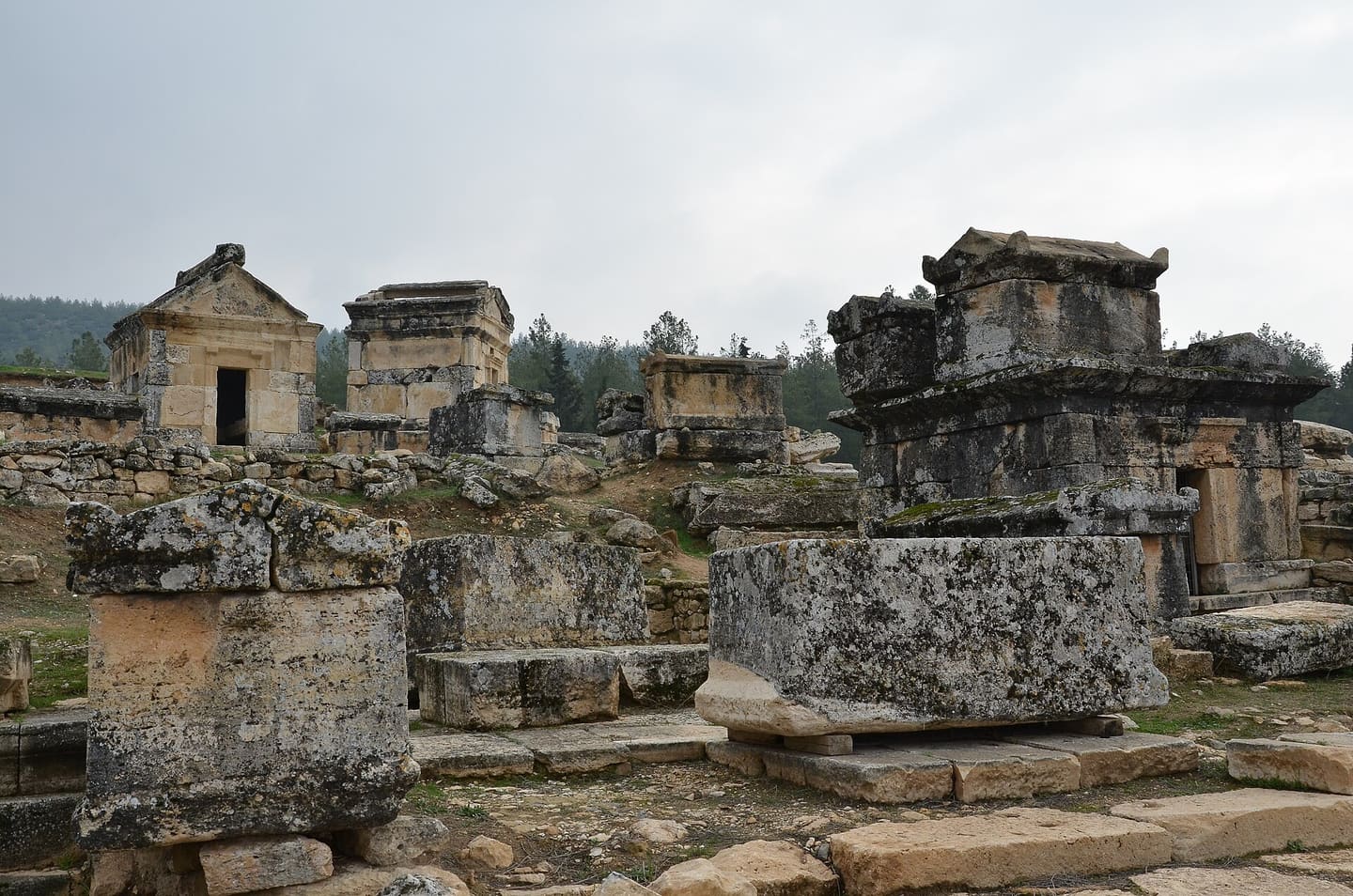
Photo: shankar s. from Dubai, united arab emirates · CC BY 2.0 (opens in a new tab) · Wikimedia Commons (opens in a new tab)
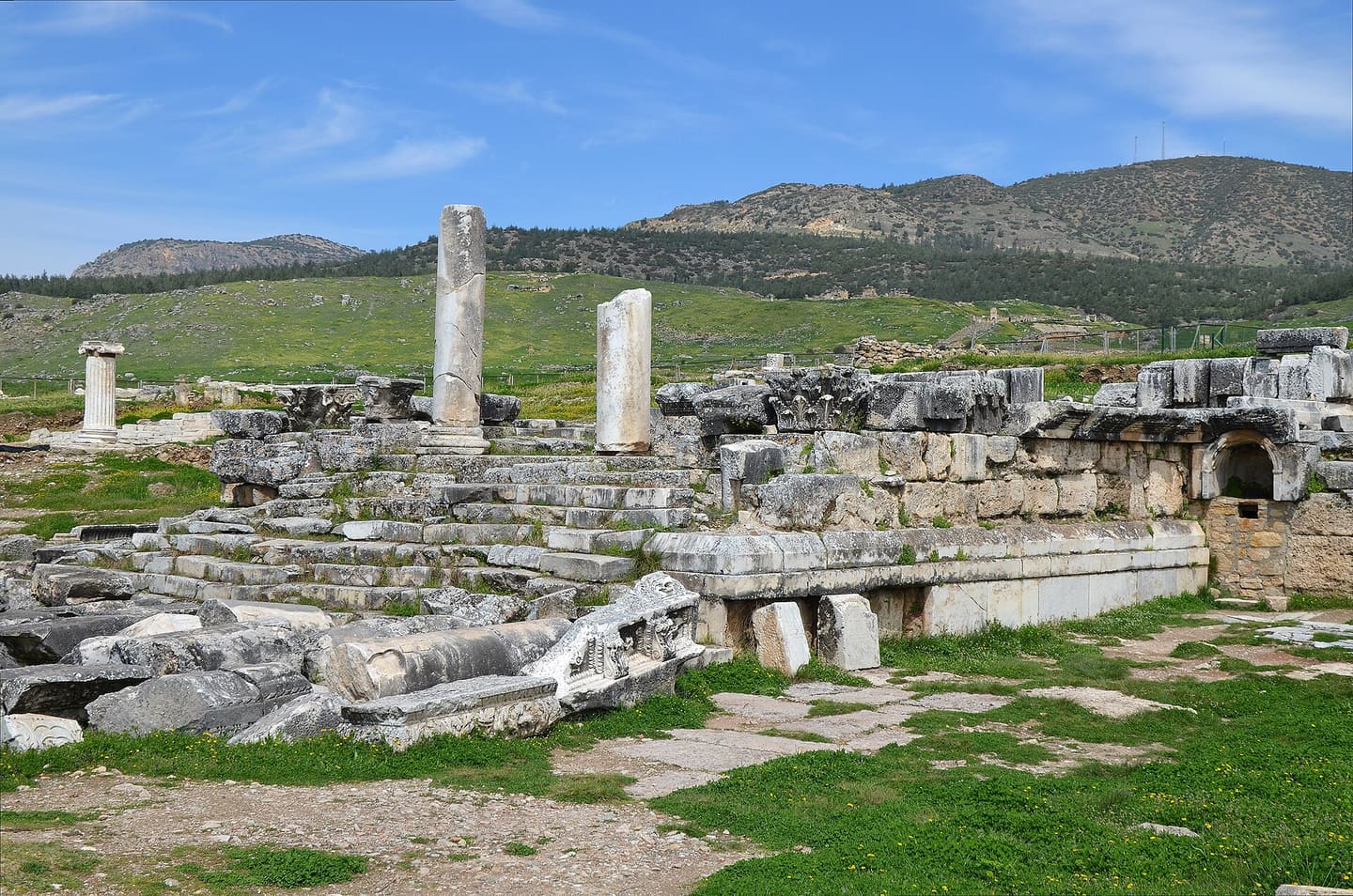
Photo: Carole Raddato from FRANKFURT, Germany · CC BY-SA 2.0 (opens in a new tab) · Wikimedia Commons (opens in a new tab)
Good to know
- The ministry lists the travertines and the ancient city together on one page, and the Archaeological Museum on a page of its own: see muze.gov.tr for both.
- The terraces are fragile and only parts of them are open: keep to the marked areas.
- Swimming in the Antique Pool costs extra, on top of the site.
- The famous sarcophagus with a picture of a water-powered stone saw (the earliest known crank and connecting rod) is not always on display.
- Laodicea, another ancient city, lies across the valley and has its own page on this site.
- The ministry runs an audio guide for the site: see its page on muze.gov.tr.
Earliest known machine with a crank and connecting rod. Hierapolis sawmill relief (sarcophagus of Marcus Aurelius Ammianos), 3rd century AD. Confirmed How sure we are →
From here
Also nearby
- 10 kmLaodicea on the Lycus
City, Hellenistic–Byzantine
- 19 kmColossae
Höyük / city, Phrygian–Roman
- museumHierapolis Archaeology Museum
Roman sarcophagi and statues
- museumLaodikeia Museum (Denizli)
Location precise · Source (opens in a new tab)